How does the manx shearwater see?
Puffinus puffinus · order Procellariiformes · Birds
The manx shearwater has four colour channels, including violet (402, 452, 503 and 566 nm).[1] Its sharpest vision resolves 8.9 cycles per degree, against 63.75 for people in this dataset.[5] Its eyes cover about 307° with 16° seen by both eyes.[12] The manx shearwater stops seeing flicker at 88.5 Hz, against 60 Hz for people.[29][30][31][32][33]
- 4colour receptor classesMeasured
- 8.9cycles per degree (sharpness)Measured
- 307°field of viewEstimated
- 88.5hertz flicker fusion (motion)Estimated
The manx shearwater (Puffinus puffinus) is a bird in the order Procellariiformes. Its eyes belong to the vision type Panoramic grain-eater and wader: four cone types, low to moderate sharpness and an almost all-round field of view. Measured in this species: colour, sharpness, field of view and night vision. Measured core: measured values on at least 3 of the 6 dials.
This is a simulation built from published eye measurements, not what the animal experiences.
What the manx shearwater sees: colour receptors
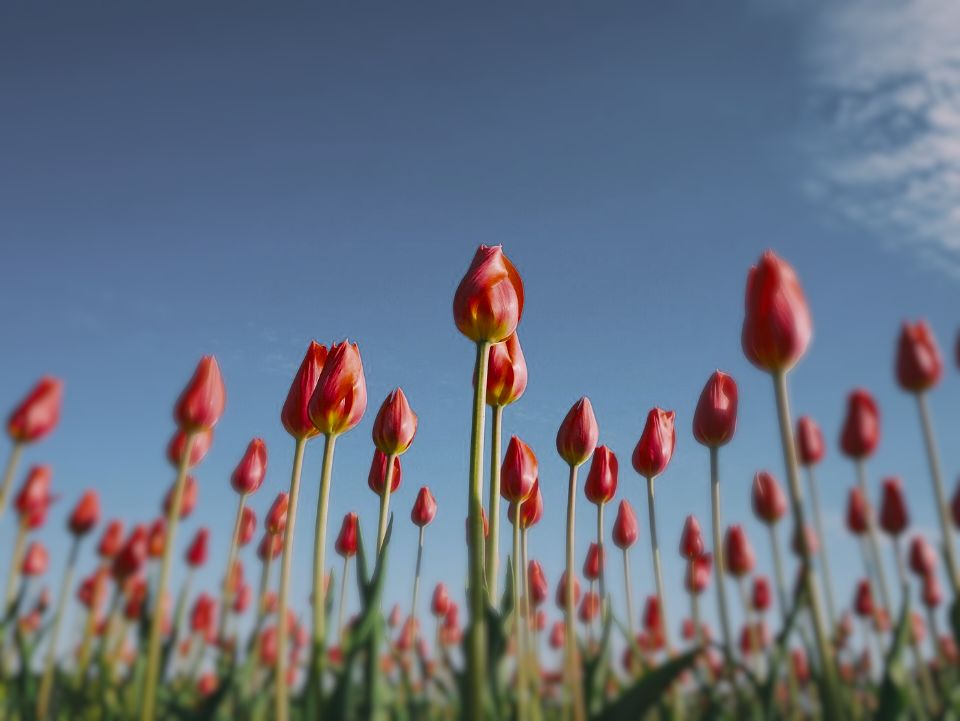
What does a manx shearwater's vision look like?
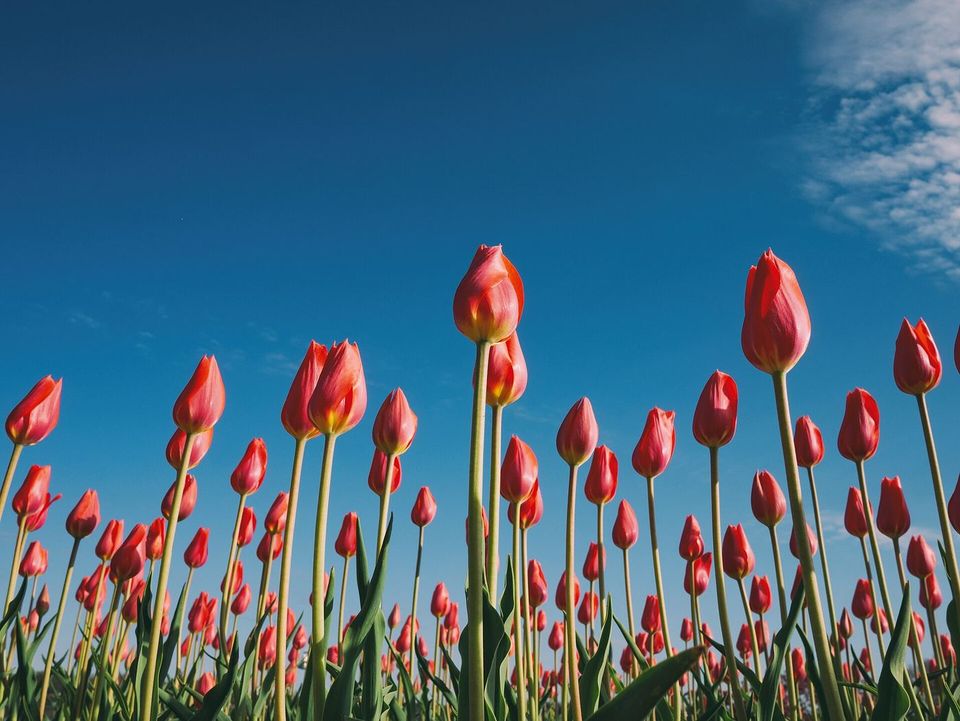
The photo above shows red tulips through this eye: drag the line to compare it with your own view. The manx shearwater has four colour channels, including violet (402, 452, 503 and 566 nm).[1] Fine detail is blurred to what 8.9 cycles per degree can resolve.
Can the manx shearwater see colour?
Yes. The manx shearwater has four colour channels, including violet (402, 452, 503 and 566 nm); people have 3.[1]
How far can the manx shearwater see?
Distance depends on the size of what is seen, so sharpness is the measure. The manx shearwater resolves 8.9 cycles per degree, against 63.75 for people in this dataset, so a detail must be about 7.2 times larger, or that much closer, for it to make it out as well as a person.[5]
Can the manx shearwater see in the dark?
The catalogue records activity pattern: diurnal and rods vs cones: cone-dominated. Night mode in the tool uses these traits by a stated engine rule, not a measured sensitivity.[17][18][1][19]
Does the manx shearwater see in slow motion?
The manx shearwater stops seeing flicker at 88.5 Hz, against 60 Hz for people in this dataset. So it sees fast motion in about 1.5 times as many steps: to it, our fast motion looks slower.[29][30][31][32][33]
How does the manx shearwater see red flowers?
The red tulips in the photo above are shown as the manx shearwater would see them: with colours remapped to its receptors, and blurred to 8.9 cycles per degree.
What stands out
- It has 4 colour receptor classes; people have 3.
- Its sharpest vision resolves 8.9 cycles per degree: the finest stripe pattern it can tell apart from grey.
- Its eyes cover about 307° around the head, with 16° seen by both eyes at once.
- It stops seeing flicker at 88.5 Hz, against 60 Hz for people in this dataset, so fast motion looks about 1.5 times slower to it.[31][32]
- Activity pattern: diurnal.
The six dials
Evidence levels: how the tiers work. "Measured" means a value measured in this species; "Estimated" values come from a close relative or an eye-size formula. The last column gives the values for people from the same catalogue.
| Dial | Value | Evidence | Sources | People |
|---|---|---|---|---|
| Colour | Colour receptors 4 receptor classes: 402 nm (VS/SWS (violet)), 452 nm (SWS (blue)), 503 nm (MWS (green)), 566 nm (LWS (long)) measured in this species | Measured | [1] | Colour receptors: 3 receptor classes: 421.5 nm (VS/SWS (violet)), 532 nm (MWS (green)), 558.4 nm (LWS (long)) Measured (not re-verified)[1][2][3][4] |
| Sharpness | Acuity 8.9 cycles per degree median of 1 anatomical-ganglion rows (method priority rule) | Measured | [5] | Acuity: 63.75 cycles per degree Measured[6][7] |
| Field of view | Binocular overlap 16° median of 1 rows (eyes-at-rest rows preferred) | Measured | [8] | Binocular overlap: 122.5° Measured[9][10] Total field of view: 200° Measured (not re-verified)[11] Blind area behind the head: 160° Derived[11] Eye placement: frontal Derived[9][10] |
| Total field of view 307° median total field (measured, or 360 - blind area) of relatives in genus Puffinus: Puffinus bailloni, Puffinus pacificus | Estimated | [12] | ||
| Blind area behind the head 53° | Estimated | [12] | ||
| Eye placement lateral frontal if binocular overlap >= 60 deg, else lateral | Derived | [8] | ||
| Sharp zones (foveas) | Number of foveas 1 median of 48 relatives in class Aves: Branta canadensis, Cardinalis cardinalis, Passerina cyanea, Zenaida macroura, Cyanocitta cristata, Junco hyemalis | Group default | [13][14][15] | Number of foveas: 1 Measured[16] Fovea type: fovea Measured[16] |
| Fovea type single central fovea (displaced dorso-temporally from retinal centre) | Group default | [13][14][15] | ||
| Night vision | Activity pattern diurnal mode of 4 rows (of 4 rows): cathemeral; diurnal; not_nocturnal | Measured (not re-verified) | [17][18][1][19] | Activity pattern: diurnal Measured (not re-verified)[20][21][22][1][23][24][25][19] Pupil shape: vertical Group default[26][27] Reflective layer (tapetum): no Measured[28] Rods vs cones: cone-dominated Derived[20][21][22][1][23][24][25][19] |
| Rods vs cones cone-dominated nocturnal -> rod-dominated; crepuscular / cathemeral / mixed -> mixed; diurnal -> cone-dominated | Derived | [17][18][1][19] | ||
| Motion (flicker fusion) | Flicker fusion frequency 88.5 Hz median of 17 relatives in class Aves: Bubo virginianus, Melopsittacus undulatus, Passer domesticus, Taeniopygia guttata, Columba livia, Calypte anna | Group default | [29][30][31][32][33] | Flicker fusion frequency: 60 Hz Measured[31][32] |
Related animals

- Wedge-tailed shearwater same vision type
- Black-browed albatross same vision type
- Leach's storm petrel same vision type
- Northern fulmar same vision type
- Tropical shearwater same vision type
- Rock pigeon same vision type
More birds: all birds with measured vision data. Same eye type: Panoramic grain-eater and wader.
Sources
- Longcore T. 2023. A compendium of photopigment peak sensitivities and visual spectral response curves of terrestrial wildlife to guide design of outdoor nighttime lighting. Basic Appl Ecol 73:40-50. doi:10.1016/j.baae.2023.09.002. doi.org/10.5281/zenodo.8432720
- Kirwan J. luxR 0.1.1: Underwater Light Analysis and Visual Ecology (R-universe), data species_sensitivities. github.com/JohnKirwan/luxR
- Müller B, Glösmann M, Peichl L, Knop GC, Hagemann C, Ammermüller J (2009) Bat eyes have ultraviolet-sensitive cone photoreceptors. PLoS ONE 4:e6390
- Thermal Activation and Photoactivation of Visual Pigments (2004)
- Caves EM, Fernandez-Juricic E, Kelley LA (2024) Ecological and morphological correlates of visual acuity in birds. J Exp Biol 227(2): jeb246063. Supplementary Table S1.. doi.org/10.1242/jeb.246063
- Kirk EC, Kay RF 2004. The evolution of high visual acuity in the Anthropoidea. In Anthropoid Origins, Table 1 (behavioural acuity). doi.org/10.1007/978-1-4419-8873-7_20
- Veilleux CC, Kirk EC 2014. Visual acuity in mammals. Brain Behav Evol 83:43, Supplementary Table 1 (cleaned CSV in Evo-M1-Trait-Data). doi.org/10.1159/000357830
- Tyrrell LP, Fernandez-Juricic E 2017. Avian binocular vision: it's not just about what birds can see, it's also about what they can't. PLoS ONE 12(3): e0173235. S1 Table.. doi.org/10.1371/journal.pone.0173235
- Heesy CP 2004. On the relationship between orbit orientation and binocular visual field overlap in mammals. Anat Rec 281A:1104, Table 1. doi.org/10.1002/ar.a.20116
- Heffner RS, Heffner HE 1992. Visual factors in sound localization in mammals. J Comp Neurol 317:219, Table 1 (via Evo-M1 sensory merge). doi.org/10.1002/cne.903170302
- species_v1:Campbell & Green 1965
- Lucas EA, Martin GR, Rocamora G, Portugal SJ. 2024. A seabird's eye view: visual fields of some seabirds (Laridae and Procellariidae) from tropical latitudes. The Science of Nature (Naturwissenschaften) 111. ESM 1.. doi.org/10.1007/s00114-024-01926-4
- Moore BA, Tyrrell LP, Pita D, Bininda-Emonds ORP, Fernandez-Juricic E 2017. Does retinal configuration make the head and eyes of foveate birds move? Sci Rep 7: 38406. Appendix 1.. doi.org/10.1038/srep38406
- Potier S, Mitkus M, Bonadonna F, Duriez O, Isard P-F, Dulaurent T, Mentek M, Kelber A 2017. Eye size, fovea, and foraging ecology in accipitriform raptors. Brain Behav Evol 90: 232-242. Supplementary material (Tables S1, S2).. doi.org/10.1159/000479783
- Rodrigues T, Matter MM, Chiodini A, et al. 2026. Foveal vision in fast-flying birds hunting on the wing. bioRxiv 2026.06.05.730304. doi.org/10.64898/2026.06.05.730304
- Kopania EEK, Clark NL. 2025. Mammalian retinal specializations for high acuity vision evolve in response to both foraging strategies and morphological constraints. Evolution Letters 9: qrae072. Supplementary Tables S1-S2.. doi.org/10.1093/evlett/qrae072
- Light conditions and the evolution of the visual system in birds (figshare dataset, SupplementaryDataset1). doi.org/10.6084/m9.figshare.22116371.v3
- Wilman H, Belmaker J, Simpson J, de la Rosa C, Rivadeneira MM, Jetz W. 2014. EltonTraits 1.0: species-level foraging attributes of the world's birds and mammals. Ecology 95:2027. BirdFuncDat.txt. doi.org/10.6084/m9.figshare.3559887.v1
- Moura et al. 2024. A phylogeny-informed characterisation of global tetrapod traits addresses data gaps and biases. PLoS Biol 22:e3002658. TetrapodTraits v3.0.1.. doi.org/10.5281/zenodo.22536349
- Anderson SR, Wiens JJ. 2017. Out of the dark: 350 million years of conservatism and evolution in diel activity patterns in vertebrates. Evolution 71:1944-1959. Dryad doi:10.5061/dryad.fg700. doi.org/10.5061/dryad.fg700
- Borges R, Johnson WE, O'Brien SJ, Gomes C, Heesy CP, Antunes A (2018) Adaptive genomic evolution of opsins reveals that early mammals flourished in nocturnal environments. BMC Genomics 19:121
- Wilman et al. 2014 EltonTraits 1.0, MamFuncDat.txt. doi.org/10.6084/m9.figshare.3559887.v1
- Maor R, Dayan T, Ferguson-Gow H, Jones KE. 2017. Temporal niche expansion in mammals from a nocturnal ancestor after dinosaur extinction. Nature Ecology & Evolution 1:1889-1895. Supplementary Table 1. doi.org/10.1038/s41559-017-0366-5
- Jones KE et al. 2009. PanTHERIA: a species-level database of life history, ecology, and geography of extant and recently extinct mammals. Ecology 90:2648. Ecological Archives E090-184. doi.org/10.1890/08-1494.1
- Schmitz L, Motani R. 2011. Science 332:705-708, SOM. doi.org/10.1126/science.1200043
- Banks MS, Sprague WW, Schmoll J, Parnell JAQ, Love GD. 2015. Science Advances 1:e1500391. doi.org/10.1126/sciadv.1500391
- Cervino NG et al. 2021. A closer look at pupil diversity and evolution in frogs and toads. Proc R Soc B 288:20211402. doi.org/10.6084/m9.figshare.15112050.v1
- Guareschi BLV, Sallum JMF, Salles MV, de Moraes JGO, Bortolini M, Cray C, Moore BA, da Rosa CC, Montiani-Ferreira F. 2025. GUCY2D-Associated Retinopathy: A Comparative Study Between Humans and German Spitz Dogs. Veterinary sciences 12(9):879. doi.org/10.3390/vetsci12090879
- Boström JE, Dimitrova M, Canton C, Håstad O, Qvarnström A, Ödeen A. 2016. Ultra-rapid vision in birds. PLoS ONE 11(3): e0151099. S1 Table. doi.org/10.1371/journal.pone.0151099
- Haarlem CS, Hynes C, Jackson AL, Mitchell KJ, O'Connell RG, Healy K. 2026. Pace of ecology drives the tempo of visual perception across the animal kingdom. Nature Ecology & Evolution (doi:10.1038/s41559-026-02994-7). Figshare dataset 10.6084/m9.figshare.30556475. doi.org/10.6084/m9.figshare.30556475
- Healy K, McNally L, Ruxton GD, Cooper N, Jackson AL. 2013. Metabolic rate and body size are linked with perception of temporal information. Animal Behaviour 86:685-696. Table 1. doi.org/10.1016/j.anbehav.2013.06.018
- Inger R, Bennie J, Davies TW, Gaston KJ. 2014. Potential biological and ecological effects of flickering artificial light. PLoS ONE 9(5): e98631. Table 3. doi.org/10.1371/journal.pone.0098631
- Lafitte A, Sordello R, Legrand M, Nicolas V, Obein G, Reyjol Y. 2022. A flashing light may not be that flashy: A systematic review on critical fusion frequencies. PLoS ONE 17(12): e0279718. S10 File (CFF database). doi.org/10.1371/journal.pone.0279718
Every value cites its sources (all sources). Values were extracted from these works and converted (units, medians, derived values); changes are ours, and the listed sources do not endorse this site. Data: catalogue-v1, built 2026-09-29. Accuracy notes: how accurate is this? Method: how we know.