How does the damara mole-rat see?
Cryptomys anselli · order Rodentia · Mammals
Estimated: the damara mole-rat has 2 colour receptor classes (400 and 530 nm): mainly blues and yellows; reds and greens look alike.[1][2] Its sharpest vision resolves 0.44 cycles per degree, against 63.75 for people in this dataset.[6] Both eyes see the same 52° in front of it.[8][9][10][11]
- 2colour receptor classesEstimated
- 0.44cycles per degree (sharpness)Estimated
- 52°seen by both eyesEstimated
- 62.5hertz flicker fusion (motion)Estimated
The damara mole-rat (Cryptomys anselli) is a mammal in the order Rodentia. Its eyes belong to the vision type Small prey mammal (UV): two or three cone types, often including ultraviolet, low sharpness and a near-panoramic field. Measured in this species: foveas and night vision. One measured dial: a value other than colour or sharpness is measured in this species; colour and sharpness are not measured here.
This is a simulation built from published eye measurements, not what the animal experiences.
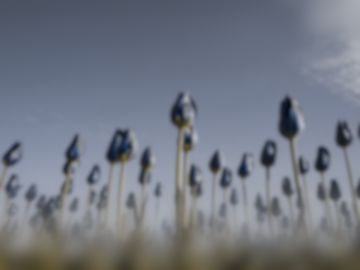
What the damara mole-rat sees: colour receptors
What does a damara mole-rat's vision look like?
Estimated: the damara mole-rat has 2 colour receptor classes (400 and 530 nm): mainly blues and yellows; reds and greens look alike.[1][2] Fine detail is blurred to what 0.44 cycles per degree can resolve.
Can the damara mole-rat see colour?
Yes. The damara mole-rat has 2 colour receptor classes (400 and 530 nm): mainly blues and yellows; reds and greens look alike; people have 3.[1][2]
How far can the damara mole-rat see?
Distance depends on the size of what is seen, so sharpness is the measure. The damara mole-rat resolves 0.44 cycles per degree, against 63.75 for people in this dataset, so a detail must be about 144.9 times larger, or that much closer, for it to make it out as well as a person.[6]
Can the damara mole-rat see in the dark?
The catalogue records activity pattern: cathemeral and rods vs cones: mixed. Night mode in the tool uses these traits by a stated engine rule, not a measured sensitivity.[14][15]
Does the damara mole-rat see in slow motion?
The damara mole-rat stops seeing flicker at 62.5 Hz, against 60 Hz for people in this dataset. So motion looks about the same speed as it does to people.[24][25][26][27]
What stands out
- It has two colour receptor classes (a dichromat): reds and greens fall on one axis, as in red-green colour blindness in people.
- Its sharpest vision resolves 0.44 cycles per degree: the finest stripe pattern it can tell apart from grey.
- Both eyes see the same 52° in front of it (binocular overlap), where depth is judged best.
- It stops seeing flicker at 62.5 Hz, against 60 Hz for people in this dataset, so fast motion looks about the same.[25][26]
- Activity pattern: cathemeral.
The six dials
Evidence levels: how the tiers work. "Measured" means a value measured in this species; "Estimated" values come from a close relative or an eye-size formula. The last column gives the values for people from the same catalogue.
| Dial | Value | Evidence | Sources | People |
|---|---|---|---|---|
| Colour | Colour receptors 2 receptor classes: 400 nm (VS/SWS (violet)), 530 nm (MWS (green)) receptor set of nearest measured relative Cavia porcellus (same order Rodentia) | Group default | [1][2] | Colour receptors: 3 receptor classes: 421.5 nm (VS/SWS (violet)), 532 nm (MWS (green)), 558.4 nm (LWS (long)) Measured (not re-verified)[1][3][4][5] |
| Sharpness | Acuity 0.44 cycles per degree median of 1 relatives in family Bathyergidae: Heterocephalus glaber | Estimated | [6] | Acuity: 63.75 cycles per degree Measured[7][6] |
| Field of view | Binocular overlap 52° median of 15 relatives in order Rodentia: Octodon degus, Octodon lunatus, Rattus rattus, Mus musculus, Mesocricetus auratus, Sciurus carolinensis | Group default | [8][9][10][11] | Binocular overlap: 122.5° Measured[8][9] Total field of view: 200° Measured (not re-verified)[12] Blind area behind the head: 160° Derived[12] Eye placement: frontal Derived[8][9] |
| Sharp zones (foveas) | Number of foveas 0 fovea_present / area_centralis_type (retinal topography; count 1 = fovea present, 0 = none) | Measured | [13] | Number of foveas: 1 Measured[13] Fovea type: fovea Measured[13] |
| Fovea type none | Measured | [13] | ||
| Night vision | Activity pattern cathemeral mode of 2 rows (of 2 rows): cathemeral | Measured (not re-verified) | [14][15] | Activity pattern: diurnal Measured (not re-verified)[16][17][14][1][18][19][20][15] Pupil shape: vertical Group default[21][22] Reflective layer (tapetum): no Measured[23] Rods vs cones: cone-dominated Derived[16][17][14][1][18][19][20][15] |
| Rods vs cones mixed nocturnal -> rod-dominated; crepuscular / cathemeral / mixed -> mixed; diurnal -> cone-dominated | Derived | [14][15] | ||
| Motion (flicker fusion) | Flicker fusion frequency 62.5 Hz median of 7 relatives in order Rodentia: Rattus norvegicus, Cavia porcellus, Mus musculus, Callospermophilus lateralis, Tamias amoenus, Tamiasciurus hudsonicus | Group default | [24][25][26][27] | Flicker fusion frequency: 60 Hz Measured[25][26] |
Related animals


- Brown rat same vision type
- House mouse same vision type
- Mongolian jird same vision type
- Syrian hamster same vision type
- Daurian ground squirrel same vision type
- Degu same vision type
More mammals: all mammals with measured vision data. Same eye type: Small prey mammal (UV).
Sources
- Longcore T. 2023. A compendium of photopigment peak sensitivities and visual spectral response curves of terrestrial wildlife to guide design of outdoor nighttime lighting. Basic Appl Ecol 73:40-50. doi:10.1016/j.baae.2023.09.002. doi.org/10.5281/zenodo.8432720
- VPOD in-vivo (MSP / single-cell) lambda max compendium, file scp_cleaned.csv, VPOD GitHub (Frazer et al. 2025 bioRxiv 10.1101/2025.08.22.671864). github.com/VisualPhysiologyDB/visual-physiology-opsin-db/tree/main/scripts_n_notebooks/vpod_ML_workflows/mine_n_match/data_sources/lmax/vpod
- Kirwan J. luxR 0.1.1: Underwater Light Analysis and Visual Ecology (R-universe), data species_sensitivities. github.com/JohnKirwan/luxR
- Müller B, Glösmann M, Peichl L, Knop GC, Hagemann C, Ammermüller J (2009) Bat eyes have ultraviolet-sensitive cone photoreceptors. PLoS ONE 4:e6390
- Thermal Activation and Photoactivation of Visual Pigments (2004)
- Veilleux CC, Kirk EC 2014. Visual acuity in mammals. Brain Behav Evol 83:43, Supplementary Table 1 (cleaned CSV in Evo-M1-Trait-Data). doi.org/10.1159/000357830
- Kirk EC, Kay RF 2004. The evolution of high visual acuity in the Anthropoidea. In Anthropoid Origins, Table 1 (behavioural acuity). doi.org/10.1007/978-1-4419-8873-7_20
- Heesy CP 2004. On the relationship between orbit orientation and binocular visual field overlap in mammals. Anat Rec 281A:1104, Table 1. doi.org/10.1002/ar.a.20116
- Heffner RS, Heffner HE 1992. Visual factors in sound localization in mammals. J Comp Neurol 317:219, Table 1 (via Evo-M1 sensory merge). doi.org/10.1002/cne.903170302
- Vega-Zuniga T, Medina FS, Fredes F, et al. 2013. Does nocturnality drive binocular vision? Octodontine rodents as a case study. PLoS ONE 8: e84199.. doi.org/10.1371/journal.pone.0084199
- Vega-Zuniga T, Medina FS, Marín G, Letelier JC, Palacios AG, Němec P, Schleich CE, Mpodozis J. (2017). Selective binocular vision loss in two subterranean caviomorph rodents: Spalacopus cyanus and Ctenomys talarum. Scientific reports
- species_v1:Campbell & Green 1965
- Kopania EEK, Clark NL. 2025. Mammalian retinal specializations for high acuity vision evolve in response to both foraging strategies and morphological constraints. Evolution Letters 9: qrae072. Supplementary Tables S1-S2.. doi.org/10.1093/evlett/qrae072
- Wilman et al. 2014 EltonTraits 1.0, MamFuncDat.txt. doi.org/10.6084/m9.figshare.3559887.v1
- Moura et al. 2024. A phylogeny-informed characterisation of global tetrapod traits addresses data gaps and biases. PLoS Biol 22:e3002658. TetrapodTraits v3.0.1.. doi.org/10.5281/zenodo.22536349
- Anderson SR, Wiens JJ. 2017. Out of the dark: 350 million years of conservatism and evolution in diel activity patterns in vertebrates. Evolution 71:1944-1959. Dryad doi:10.5061/dryad.fg700. doi.org/10.5061/dryad.fg700
- Borges R, Johnson WE, O'Brien SJ, Gomes C, Heesy CP, Antunes A (2018) Adaptive genomic evolution of opsins reveals that early mammals flourished in nocturnal environments. BMC Genomics 19:121
- Maor R, Dayan T, Ferguson-Gow H, Jones KE. 2017. Temporal niche expansion in mammals from a nocturnal ancestor after dinosaur extinction. Nature Ecology & Evolution 1:1889-1895. Supplementary Table 1. doi.org/10.1038/s41559-017-0366-5
- Jones KE et al. 2009. PanTHERIA: a species-level database of life history, ecology, and geography of extant and recently extinct mammals. Ecology 90:2648. Ecological Archives E090-184. doi.org/10.1890/08-1494.1
- Schmitz L, Motani R. 2011. Science 332:705-708, SOM. doi.org/10.1126/science.1200043
- Banks MS, Sprague WW, Schmoll J, Parnell JAQ, Love GD. 2015. Science Advances 1:e1500391. doi.org/10.1126/sciadv.1500391
- Cervino NG et al. 2021. A closer look at pupil diversity and evolution in frogs and toads. Proc R Soc B 288:20211402. doi.org/10.6084/m9.figshare.15112050.v1
- Guareschi BLV, Sallum JMF, Salles MV, de Moraes JGO, Bortolini M, Cray C, Moore BA, da Rosa CC, Montiani-Ferreira F. 2025. GUCY2D-Associated Retinopathy: A Comparative Study Between Humans and German Spitz Dogs. Veterinary sciences 12(9):879. doi.org/10.3390/vetsci12090879
- Haarlem CS, Hynes C, Jackson AL, Mitchell KJ, O'Connell RG, Healy K. 2026. Pace of ecology drives the tempo of visual perception across the animal kingdom. Nature Ecology & Evolution (doi:10.1038/s41559-026-02994-7). Figshare dataset 10.6084/m9.figshare.30556475. doi.org/10.6084/m9.figshare.30556475
- Healy K, McNally L, Ruxton GD, Cooper N, Jackson AL. 2013. Metabolic rate and body size are linked with perception of temporal information. Animal Behaviour 86:685-696. Table 1. doi.org/10.1016/j.anbehav.2013.06.018
- Inger R, Bennie J, Davies TW, Gaston KJ. 2014. Potential biological and ecological effects of flickering artificial light. PLoS ONE 9(5): e98631. Table 3. doi.org/10.1371/journal.pone.0098631
- Lafitte A, Sordello R, Legrand M, Nicolas V, Obein G, Reyjol Y. 2022. A flashing light may not be that flashy: A systematic review on critical fusion frequencies. PLoS ONE 17(12): e0279718. S10 File (CFF database). doi.org/10.1371/journal.pone.0279718
Every value cites its sources (all sources). Values were extracted from these works and converted (units, medians, derived values); changes are ours, and the listed sources do not endorse this site. Data: catalogue-v1, built 2026-09-29. Accuracy notes: how accurate is this? Method: how we know.